Two men were walking down the street; and the short one said to the tall one, “Why is your head all bandaged up?” The tall one hesitated a minute, stopped on a dime, turned and said, “I got hit with a bunch of tomatoes.” The short fellow looked perplexed. “Think I’m dumb as a post?” he said. “Tomatoes squish, they don’t cut you up like that.” The tall one shrugged. “They were still in the can,” he said.
Metonymy, unlike monotony, rarely leaves a dull moment in its wake. Miss Groby (see The Thurber CarnivalI, p.52, 1945) defined it, generally, as a figure of speech, and, specifically, as the container for the thing contained. Container for … ? This part of Miss Groby’s definition leaves me in left field. Metonymy derives from the Greek metōnymia, meaning ‘a change of name,’ and thus simply means substituting one word or phrase for another. The bull pen does not contain bulls; within the confines of this pen reside relief pitchers waiting their call to battle. No new thing—metonymy, not bull pens— they began appearing in English around the 1560s. To clear the air, metaphors use similarity to compare two things. Metonymies also compare, but use two items that are contiguous but dissimilar to make their point. A screwball is not just your neighbor’s eldest son, but rather a pitch developed by Christy Matthewson which, with an outward snap of the wrist, spins and twists in a direction opposite that of the curve ball. People, like baseballs, often go in unlikely directions.
If you are sly as a fox, you get my drift. If your comprehension is lagging, you need to ketchup. If you need me to lend you a hand, metonymy is your game. Figures of speech are one of the staples of literature. They are so ingrained in our psyche that we gloss right over them, missing the trees for the forest. Indeed, the prevailing wisdom these days is that consciousness—however you would like to deal with that term—is simply (ha!) metaphoric, in the broadest sense of the word. Consider this quote from an essay featured on the website Sonnets In Color:
Because consciousness requires us to constantly model our immediate experience through metaphorical lenses, it is inherently an illusion. As Jaynes noted, there is nothing in our immediate experience that is actually “like” immediate experience itself, making metaphor the only way the mind can conceptualize its own existence.
Illusion or not, consciousness rendered by a master craftsman as literature, seems real enough to set the weightier psychological and philosophical considerations on the back burner. Figures of speech, taken as they come, provide enough zest to entertain even the most inveterate dullard.
Dickens (1812 – 1870), some claim, depended on figures of speech to such an extent that he diluted what might have been great literature to something akin to pulp fiction. Most of his novels were set in London, and commonly were described metonymically. In Bleak House (1853), the dense fog of vapor, soot, tars and who-knows-what, that enshrouded the city, becomes his metonymic substitute for the city itself as well as for the stagnation and blindness of the courts.
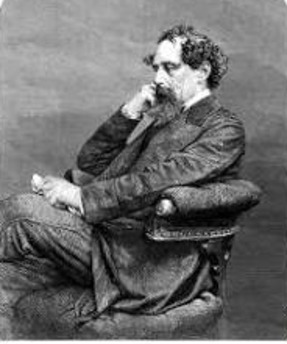
Charles Dickens
The fifth paragraph of the novel graphically presents the setting:
Never can there come fog too thick, never can there come mud and mire too deep, to assort with the groping and floundering condition which this High Court of Chancery, most pestilent of hoary sinners, holds this day in the sight of heaven and earth.
Fog persists as the metonomic figure of speech throughout the novel, no mean feat, as any self-respecting novelist will tell you.
The reclusive Emily Dickinson (1830 – 1886) who, it seems, wrote voraciously—at her death her sister found, neatly gathered, manuscripts of some 1775 poems—was adept at integrating figures of speech, including many metonymies, into her verse. ‘There’s a certain Slant of light’ (1861) describes the oppression of the gloom that comes with winter light, and then extends the comparison to turbid cathedral music and spiritual despair. She manages to evoke an ineluctable sadness and ends the poem with ‘the look of death.’ The last stanza reads:
When it comes, the Landscape listens –
Shadows – hold their breath –
When it goes, ’tis like the Distance
On the look of Death –

Emily Dickinson
And that brings us by a commodious recirculation of literary byways to Samuel Clemens and Mark Twain. They died some time ago, but both are still relevant. Pen names, nom de plumes, are not metonymies; though one name does substitute for another, they are not necessarily contiguous. Pen names hide while metonymies illuminate. Euphemism, on the other hand, is often metonymy. ‘Powder room’ when used for ‘toilet’ is such a phrase. Bathroom, for that matter, is or was a euphemistic metonymy. Ultimately, it is time and geography and the human proclivity for invention that blur and beget the infinite oddities of language.


Leave a Reply