
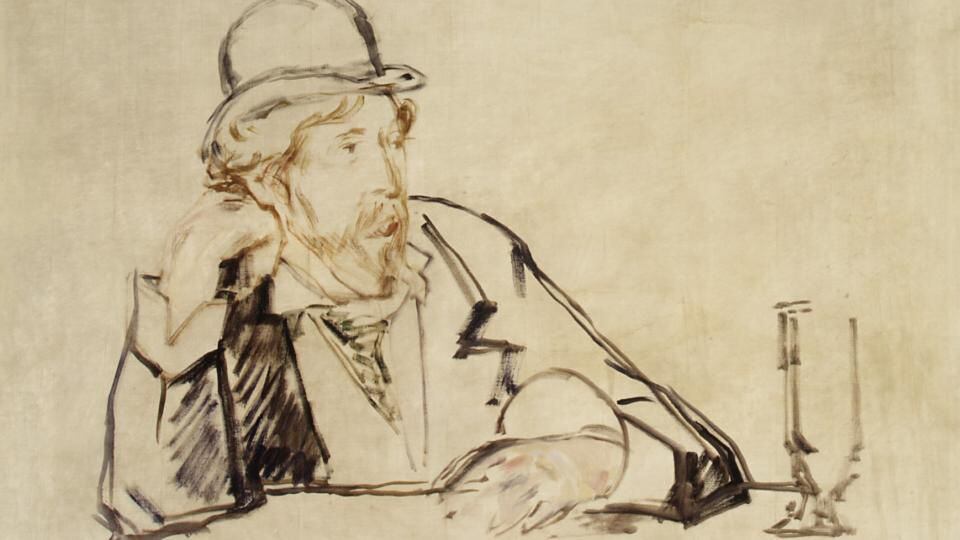
A sketch of George Moore by his friend Edouard Manet
If one were to rank Irish writers, George Moore (1852 – 1933) would certainly be among the top tier. Despite his excellent reputation, his work is generally considered to be outside the purview of British Victorian literature. He remains ‘other,’ perhaps French perhaps some hybrid. Influenced by French naturalism, his stories and novels focused on themes that were anathema to the literary conventions of the late 19th century, exploring subjects that ranged from religious hypocricy to prostitution.
Despite all criticism, Moore remains the first great Irish novelist whose influence extended to James Joyce and W. B. Yeats. His finest novel, Esther Waters (1894), has been in print for over one hundred years.
To friends, readers, and critics, he was better known as simply GM. Born in Carnacun, near Claremorris, County Mayo, in 1852, he spent significant periods of his life in Paris and Dublin, and died in London in 1933. He was always putting pen to paper, completing 65 books, though many exist in multiple editions for, perfectionist that he was, GM revised constantly.
The Untilled Field (1903) and The Lake (1905) are two of Moore’s significant works, often published together in collections. The books explore Irish rural life, tradition, and the tension between the old ways and modernity. The Untilled Field is a collection of interconnected short stories, while The Lake is a poetic novel, both with a rare psychological depth and poignant portraits of Irish characters grappling with love, loss, and societal constraints.
“Julia Cahill’s Curse,” one of many excellent short stories by Moore, is set in a small Irish village, and tells a tale of ostracism and intolerance. She is condemned by the local priest, and this leads eventually to her emigration to the United States.
Julia leaves the village with a curse, vowing that every year a roof will collapse, and a family will follow her to America. This touch of Irish mysticism serves as the common thread that runs through the story. Social and religious criticism brings out the complexities of what seems to be simple rural life.
What follows is an excerpt from the story. A link is provided to Project Gutenberg for readers who wish to read the entire story. The link accesses PG’s publication of The Untilled Field. ‘Julia Cahill’s Curse’ is Chapter Vi.
On an outside car one divides one’s time in moralising on the state of the country or in chatting with the driver, and as the driver seemed somewhat taciturn I examined the fields as we passed them. They were scanty fields, drifting from thin grass into bog, and from bog into thin grass again, and in the distance there was a rim of melancholy mountains, and the peasants I saw along the road seemed a counterpart of the landscape. “The land has made them,” I said, “according to its own image and likeness,” and I tried to find words to define the yearning that I read in their eyes as we drove past. But I could find no words that satisfied me.
“Only music can express their yearning, and they have written it themselves in their folk tunes.”
My driver’s eyes were the eyes that one meets everywhere in Ireland, pale, wandering eyes that the land seems to create, and I wondered if his character corresponded to his eyes; and with a view to finding if it did I asked him some questions about Father Madden. He seemed unwilling to talk, but I soon began to see that his silence was the result of shyness rather than dislike of conversation. He was a gentle, shy lad, and I told him that Father O’Hara had said I would see the loneliest parish in Ireland.
“It’s true for him,” he answered, and again there was silence. At the end of a mile I asked him if the land in Father Madden’s parish was poor, and he said no, it was the best land in the country, and then I was certain that there was some mystery attached to Father Madden.
“The road over there is the mearing.”
And soon after passing this road I noticed that although the land was certainly better than the land about Culloch, there seemed to be very few people on it; and what was more significant than the untilled fields were the ruins, for they were not the cold ruins of twenty, or thirty, or forty years ago when the people were evicted and their tillage turned into pasture, but the ruins of cabins that had been lately abandoned. Some of the roof trees were still unbroken, and I said that the inhabitants must have left voluntarily.
“Sure they did. Arn’t we all going to America.”
“Then it was not the landlord?”
“Ah, it’s the landlord who’d have them back if he could.”
“And the priest? How does he get his dues?”
“Those on the other side are always sending their money to their friends and they pay the priest. Sure why should we be staying? Isn’t the most of us over there already. It’s more like going home than leaving home.”
I told him we hoped to establish new looms in the country, and that Father O’Hara had promised to help us.
“Father O’Hara is a great man,” he said.
“Well, don’t you think that with the revival of industries the people might be induced to stay at home?”
“Sorra stay,” said he.
I could see that he was not so convinced about the depopulation of Father O’Hara’s parish as he was about Father Madden’s, and I tried to induce him to speak his mind.
“Well, your honour, there’s many that think there’s a curse on the parish.”
“A curse! And who put the curse on the parish?”
“Isn’t that the bell ringing for Mass, your honour?”
And listening I could hear a doleful pealing in the grey sky.
“Does Father Madden know of this curse?”
“Indeed he does; none better.”
“And does he believe in it?”
“There’s many who will tell you that he has been saying Masses for the last ten years, that the curse may be taken off the parish.”
We could now hear the bell tolling quite distinctly, and the driver pointed with his whip, and I could see the cross above the fir-trees.
“And there,” he said, “is Bridget Coyne,” and I saw a blind woman being led along the road. At the moment I supposed he had pointed the woman out because she was blind, though this did not seem a sufficient reason for the note of wonder in his voice; but we were within a few yards of the chapel and there was no time to ask him who Bridget Coyne was. I had to speak to him about finding stabling for the horse. That, he said, was not necessary, he would let the horse graze in the chapel-yard while he himself knelt by the door, so that he could hear Mass and keep an eye on his horse. “I shall want you half an hour after Mass is over.” Half an hour, I thought, would suffice to explain the general scope of our movement to Father Madden. I had found that the best way was to explain to each priest in turn the general scope of the movement, and then to pay a second visit a few weeks later. The priest would have considered the ideas that I had put into his head, he would have had time to assimilate them in the interval, and I could generally tell in the second visit if I should find in him a friend, an enemy, or an indifferent.
There was something extraordinary in the appearance of Father Madden’s church, a few peasants crouched here and there, and among them I saw the blind woman that the driver had pointed out on the road. She did not move during Mass; she knelt or crouched with her shawl drawn over her head, and it was not until the acolyte rang the communion bell that she dared to lift herself up. That day she was the only communicant, and the acolyte did not turn the altar cloth over the rails, he gave her a little bit of the cloth to hold, and, holding it firmly in her fingers, she lifted up her blind face, and when the priest placed the Host on her tongue she sank back overcome.
“This blind woman,” I said to myself, “will be the priest’s last parishioner,” and I saw the priest saying Mass in a waste church for the blind woman, everyone else dead or gone.

 ESP.LITERATURE
Leave a comment