A side of Edgar Allen Poe (1809 – 1849) that is lost in the eccentricities of his life and the sensationalism of his prose and poetry is his consistent advocacy for women writers. Elizabeth Akers Allen (nee Chase) was but seventeen when Poe died; but she was familiar with the circle of writers in New York City that he had championed. Though Elizabeth Allen was one of the foremost poets of the 19th century, her work and that of many others (as well as Poe’s reputation) got swept away by the rise of Modernism and the vituperous bleating of misogynists such as T. S. Eliot, Ezra Pound, and Henry Adams.
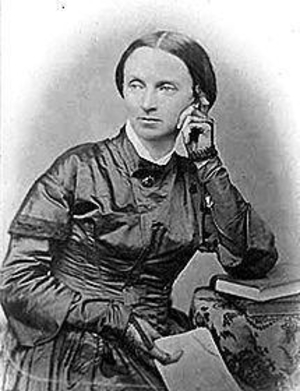
The Grammar School Act of 1840 and the Education Act of 1870 had made literacy widespread in England; and newspapers and periodicals flourished. Women in particular took advantage of the demand for the written word, the number living by their pen at least to some degree, swelled to equal the number of male writers. Rough estimations put the number of novels published during the Victorian Era (1837 – 1901) at 50,000 with 3500 writers working assiduously to fill the demand.
Modernism, perhaps a misnomer, was a movement that condemned sentimentalism and romanticism to a dusty back shelf; but the early 20th century was not the best of times for women generally. A few facts that make the case: Women in England over the age of 30 did not get the right to vote until 1918, women 21 – 30 waited until 1928. Suffrage for women was enacted in the United States in 1920. Oxford did not admit a woman into their hallowed halls until 1920. The Treaty of Versailles, ending the first world war, contained a clause that gave equal pay for women, a clause that was universally ignored. In the United States, women’s wages were far from equal; in the 1920s, many women’s wages were consistently reported as just 59% of men’s wages.
Luck rarely ran with Elizabeth Akers Allen. Her maiden name was Elizabeth Anne Chase, born in 1832 in Strong, Maine. Her mother died when she was an infant, and her father moved the family to Farmington. Suffering beatings and isolation in the cellar at the hands of a stepmother, she left home at thirteen, and managed to find work in a bookbindery, and gain entrance into Farmington Academy with hopes of a career as a teacher.
She was, apparently, something of a child prodigy. At 15, her poems were published in the Farmington newspaper under the pen name ‘Florence Percy.’ Her first book of poetry was published in 1855. She started contributing poems to the Atlantic Monthly in 1858. In 1866, she published her second collection, Poems, under the name of ‘Elizabeth Akers,’ and her last book, The Sunset Song and other verses was also written under that name.
It comes as no surprise that the inscription on Mrs Allen’s cenotaph reads:
ELIZABETH AKERS
GIFTED WRITER KEEN CRITIC
RARE POET
1832 – 1911
Was she ‘Mrs Allen’ in name only? Four years after her death, in June 1915, her friend Gilbert Tracy had the memorial erected in her honor in Westfield Cemetery, Danielson, Connecticut. She had corresponded with Tracy regularly throughout the last years of her life. When asked why she had become so reclusive, she wrote: “I have refused many an invitation to literary symposiums, and ‘receptions,’ only for a reason that my hands were so scarred and rough from hard ‘house-work’ that I am ashamed of them.” Tracy, through their exchange of letters, might have known the extent of that ‘hard house work,’ and just how much her indolent third husband, Elijah Allen, had contributed to the drudgery of her days.
Her first marriage lasted only a few years; she and her infant daughter were abandoned by a partner who chose to chase dreams of gold in California. Her second marriage was to a young and talented sculptor with whom she had traveled to Italy in 1859; but Paul Akers had contracted tuberculosis and he died in 1861. Just a few months later, their infant child died. Her life at this point must have seemed like some macabre story by Poe.
She moved to Washington D. C., where she was able to find employment at the war office. Her misfortune followed her: she was in the audience when Lincoln was assassinated. Her third marriage, to E. M. Allen, while troubled, lasted. He was often gone which may have served her better than otherwise.
For most of her life, her ability as a journalist gave her the means to be self-sufficient. The success of her first book allowed her to travel to Europe in 1859–60, serving while there as a correspondent for the Portland Transcript and the Boston Evening Gazette. In 1874, she moved to Portland, Maine, where she spent seven years as the literary editor of the Daily Advertiser. Most accounts place Elizabeth and her husband in Tuckahoe from 1881 until her death in 1911. However, her letters to Gilbert Taylor and other friends, along with some degree of financial independence, suggest that she spent a good part of her time in New York City. A well established rail line linked the city with Tuckahoe, just 20 miles north. She published four collections of her verse including Queen Catherine’s Rose (1885), The High-Top Sweeting (1891), The Ballad of the Bronx (1901), and Sunset Song and other verses (1902) during the time her husband kept a house in Tuckahoe.
A capable, self-sufficient individual, her ingenuity as a poet set her apart as one of the most accomplished female writers of her time. Her hard life, exemplified by her rough hands, added grit, realism to the sentiment of her lines, and an honesty that is absent from the ‘run of the mill’ poetry of the Victorian era. ‘At Last,’ is a poem from her book Poems which was published in 1866 under the name Elizabeth Akers. ‘Truth And Beauty’ was never included in any of her books, but may have been published in a newspaper or journal.
AT LAST
At last, when all the summer shine
That warmed life's early hours is past,
Your loving fingers seek for mine
And hold them close—-at last—-at last!
Not oft the robin comes to build
Its nest upon the leafless bough
By autumn robbed, by winter chilled,—-
But you, dear heart, you love me now.


Though there are shadows on my brow
And furrows on my cheek, in truth,—-
The marks where Time's remorseless plough
Broke up the blooming sward of Youth,—-
Though fled is every girlish grace
Might win or hold a lover's vow,
Despite my sad and faded face,
And darkened heart, you love me now!


I count no more my wasted tears;
They left no echo of their fall;
I mourn no more my lonesome years;
This blessed hour atones for all.
I fear not all that Time or Fate
May bring to burden heart or brow,—-
Strong in the love that came so late,
Our souls shall keep it always now!
TRUTH  AND BEAUTY
Strange Truth and Beauty are enemies,
Treading forever on each other's toes!
Strange rhymes are always made of that which is
Too false or silly to be said in prose!
Now here's a sonnet by our village poet
"Inscribed to Kate," in most romantic style,
Whereas,—and one with half an eye might know it,—
He means Sophronia Tompkins, all the while.
He sings of "golden curls." If fiery tresses
Had heat to match their hue, her hair would burn;—
He mentions "airy grace,"—while she possesses
A form as shapeless as an old-time churn,
Heavens! after this I never shall inquire
Why people always call the poet's song a LYRE!
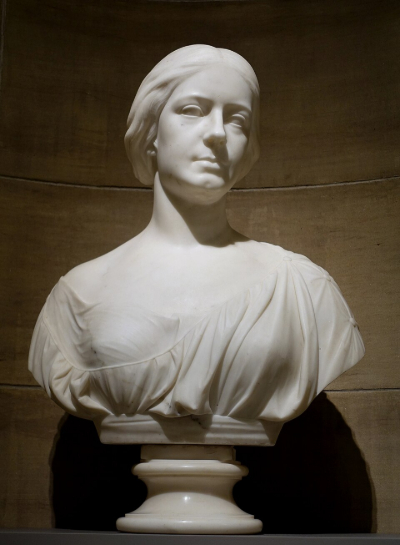
Bust of Elizabeth Akers
By Paul Akers 1859


Leave a Reply