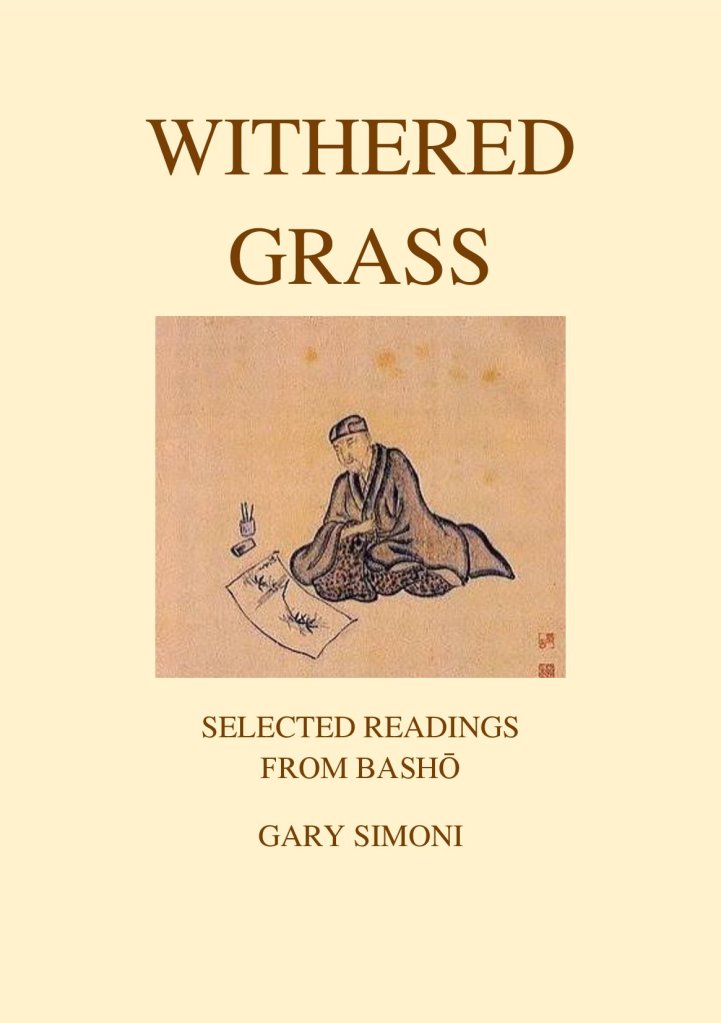
excerpt from WITHERED GRASS —Selected Readings From Basho
All translators face similar issues. Regardless, several good translations of Bashō’s work exist. Withered Grass serves up a very limited selection of the poet’s work; and the translations are impressionistic. Less is more is always the guiding principle. Gary Snyder’s observation regarding Chinese poetry (and some of his own) holds here. Snyder wrote (from Riprap And Cold Mountain Poems—1965):
The idea of a poetry of minimal surface texture, with its complexities hidden at the bottom of the pool … a dark old lurking, no fancy flavor, is ancient.
I begin with my translation of a haiku from Basho’s book The Narrow Road To The Deep North (Nobuyuki Yuasa, translator), which is followed by a commentary, and then the same haiku as translated by Nobuyuki and, finally, Jane Reichhold’s translation from her book Basho, The Complete Haiku.
strumpets shared my inn—clover and moon
家 に 遊 女もねたり萩 と 月
hitotsuya ni yūjo mo netari hagi to tsuki
As all travelers know, the unexpected provides spice to the daily slog. Some think that the poet invented the story of his night with the idle ladies to add a bit of flavor to his chronicle. For the most part, Bashō recorded what he saw, or rather what he thought and felt about what he saw and experienced. “The longest journey brings us deepest within ourselves.” Or so he thought. Whatever the case, traveling, like misery, often makes for strange bedfellows.
Uncertainty surrounds these lines. Did Bashō invent them to add a ‘love interest’ as is often done in renga poetry? Sora, his companion for much of the journey, does not mention the incident.
INDIVIDUAL FORMS
The radical for asobu (走) is on the left side of this kanji, and gives the meaning ‘to run.’ Child 子 is on the right side generally thought to be playing— running about?—carrying a flag.
Combined the concepts of relaxing, idling, etc are derived.
The kanji for woman 女 is derived from a pictograph of a woman kneeling at work.
The combination of asobu and onna gives idle woman which can be rendered as pejoratively as one wishes.
萩, はぎ (hagi) is defined as bush clover, Japanese clover (any flowering plant of genus Lespedeza). The word is most commonly written in modern Japanese using hiragana alone. Bush clover is a prominent seasonal symbol for the arrival of autumn, transient beauty, and quiet, bittersweet longing.
TRANSLATION from The Narrow Road To The Deep North (Nobuyuki, p132):
Under the same roof
We all slept together,
Concubines and I—
Bush-clovers and the moon.
TRANSLATION from Basho, The Complete Haiku (Reichhold, p143):
in one house
prostitutes lie down to sleep
bush clover and the moon
WITHERED GRASS is a translation of selected prose excerpts and various poems written by the 17th century Japanese wordsmith Bashō. Two versions of Japanese, character and romanization, and an English translation are presented. The ideograms or characters of Japanese (like their Chinese counterparts) are representational. Our alphabet is symbolic. Including both versions of the poem provides some depth of understanding

 ESP.LITERATURE
Leave a comment